On kinship
Life, connections, oneness and the pursuit of love

Last week, my brother handed over an old diary belonging to my father. An entry from 1977 by my mother stopped us both in our tracks. My father was admitted to a hospital in Goregaon, Bombay for what eventually turned out to be typhoid. My brother recalled that a friend’s father accompanied him to the junior college (Parle college) to get admission since dad was indisposed.
However, what struck me was that he was treated by Dr. Shenoy. The kind doctor treated my father later in 1988 when he was suffering from heart disease. Dr. Shenoy’s son Narendra, was my senior in the engineering college that we both went to. So, I wrote to him and attached this image.
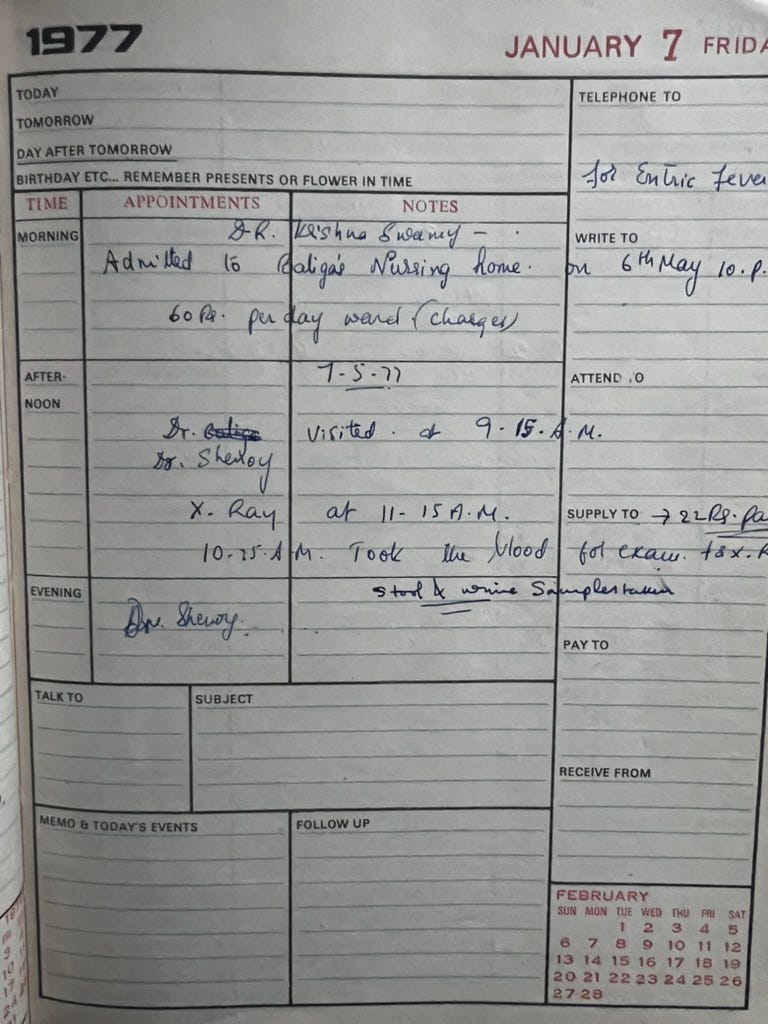
Narendra Shenoy wrote this wonderfully poetic response to the entry.
Thanks so much for sharing this, Arun! It’s so amazing that your parents used to maintain a diary and that it’s there with you. Handwritten notes are such powerful windows into the past. If you think about it, we’re just living inside our heads, like Descartes said. It’s a billion thoughts, most of them illegible due to the passage of time, yet all strung together in a big, tangled mess of a story. This story is a mess for literally everyone else other than ourselves, but for us, the owner of the head in which this story resides, that is, it not only makes perfect sense regardless of where you pick up a thread, it’s also smoothly connected with the past and future of that moment. A bit like those functions we used to have in calculus - “continuous and differentiable at all points” - And then, you get evidence like this beautiful little diary entry, and the thread stops being just something that exists in that tangled mess. It becomes real. A real person -your mother- wrote it. She picked up a pen, sat deliberately, opened the diary, possibly sitting at the dining table, and carefully wrote down that entry.. She wrote down “Dr. Baliga”, then scratched it out and rewrote “Dr. Shenoy”, and that he visited at 9.15 am. That morning became real for me too, just like it did, for you. I can imagine your father lying in bed, his pulse and blood pressure likely being taken. Your mother, standing there, asking my father what he thought was the severity of the infection and when he might be discharged. My father came alive for me. I could imagine him telling her it wasn’t anything serious, just have plenty of fluids and avoid oily food or something along those lines. She would have packed your tiffin box and sent you to school before coming here. She probably left a little later to prepare lunch and get it to the hospital. And would have to hurry back to be there when you returned from school. My father, I know, would hurry off to his clinic in Malad, after doing his rounds at Baliga. He would probably return in the evening and have another look. “Everything ok?” he would ask the on-duty sister and having gotten an affirmative answer, moved on to the next patient. A small diary entry that connects the two of us, forty eight years after it was written.
All this adds itself to the big pile already inside my head. It settles in, like powdered sugar sprinkled on to a moist buttered toast, visible for a while, and then dissolving into invisibility. But its there, I know, because the toast is sweeter.
which reminded me of my idol Jane Hirshfield’s poem about a bucket of water. I’ve written about Hirshfield before in Love and Fire. This excerpt is from Emergence Magazine.
JH And that is in some way comforting to all of us who feel like, why aren’t I walking in total openness to the mystery all of the time? When you see that every single great mystic—you know, St. John the Divine, Hildegard of Bingen, Mirabai—every tradition, the dark nights of the soul come after the great experience of opening as well as before it. And this is because the leash is strong. And I have a theory. I can’t justify the theory, you know, I’m a poet, not a scientist. And I doubt that even scientists will ever quite be able to say, oh yeah, that’s right, or that’s wrong. But I think that one reason it is so difficult for human beings to step outside ego and fear and self-concern is because evolution built us to be self-concerned. If you want to survive the dangerous world where you might be eaten by a tiger, maybe it’s a good idea to have some sense of self-protection. And so in a way, the great mystics are transcending evolution itself and how much our brains and bodies have been attuned to survival, just pure survival—not wanting to be hungry, not wanting to be the one who is eaten. That’s evolution. And so slipping the leash is recognizing that in many, many circumstances we can set that down.
I think, to go to a different explanation system yet, I have always loved the psychologist Maslow’s hierarchy of needs, in which he says: First, people need safety, shelter, food. And then there is this pyramid of, what do you need before you will be able to feel free to engage in art, to feel free to engage in generosity, to feel free to not put your own self-preservation as the glasses you look at the world through. And so the great mystics—the truly great mystics—they are able to do this even when they are cold, hungry, and in peril. And maybe that’s one of the things that meditation or prayer or long abiding, in the sense of the divine or the large—whatever language one wants to put onto this experience—it shows you that you are always safe and the world is always abundant if your own next meal is not the most important thing.
EV: Can I ask you to read your poem from Ledger, “A Bucket Forgets Water”?
JH: Yes.
A Bucket Forgets Its Water
A bucket forgets its water,
its milk, its paint.
Washed out, re-used, it can be washed again.
I admire the amnesia of buckets.
How they are forthright and infinite inside it,
simple of purpose,
how their single seam is as thin of rib as a donkey’s.
A bucket upside down
is almost as useful as upright—
step stool, tool shelf, drum stand, small table for lunch.
A bucket receives and returns all it is given,
holds no grudges, fears,
or regret.
A bucket striking the mop sink rings clearest when empty.
But not one can bray.
For what binds us
There are names for what binds us:
strong forces, weak forces.
Look around, you can see them:
the skin that forms in a half-empty cup,
nails rusting into the places they join,
joints dovetailed on their own weight.
The way things stay so solidly
wherever they’ve been set down—
and gravity, scientists say, is weak.
And see how the flesh grows back
across a wound, with a great vehemence,
more strong
than the simple, untested surface before.
There’s a name for it on horses,
when it comes back darker and raised: proud flesh,
as all flesh,
is proud of its wounds, wears them
as honors given out after battle,
small triumphs pinned to the chest—
And when two people have loved each other
see how it is like a
scar between their bodies,
stronger, darker, and proud;
how the black cord makes of them a single fabric
that nothing can tear or mend.
what fascinates me is also the format of the diary itself - "phone to", "attend do", "write to" etc. maybe i should vibe code something that takes my unstructured thoughts and organizes it into a diary like that!